Go straight to page content

Meet both games and explore the demo results

Meet the Chicken Road Game, Its Modes and Our Test

Chicken Road is InOut’s casino crossing game, with a choice to collect after successful steps. Find the free demos, compare the two versions and read our own test of 12,000 rounds.

Play free demo
RTP stated by the developer 98% Modes 4 Upper payout amount 10,000 USD Bet range 0.01–150 USD

Chicken Road Wins research team

Chicken Road game artwork
Our demo capture18+

Practice balance

Chicken Road
Chicken Road

Free practice credits. No withdrawals. Adults 18+.

RTP stated by the developer: 98% · Upper payout amount: 10,000 USD · Naira for your personal budget: NGN (₦); USD amounts describe the provider's game limits

Read the full title breakdown
2Games, separate facts
4Difficulty modes
98%Provider RTP · original game
12,000Recorded demo rounds

Pick your road

4 modes. Different ladders.

A harder mode changes the steps and multipliers. It does not make the next outcome predictable.

Easy setting

24 Steps

19.44×Final step coefficient · original game

Medium setting

22 Steps

1,788.8×Final step coefficient · original game

Hard setting

20 Steps

41,321.43×Final step coefficient · original game

Daredevil setting

15 Steps

2,542,251.93×Final step coefficient · original game

Coin artwork is decorative. The figures above come from the recorded game configuration.

Our test

12,000 demo rounds

Continued to loss or completion. Observations only. No outcome forecasts.

Easy setting95.47%Range of statistical uncertainty: 94.29%–96.41%
Medium setting87.8%Range of statistical uncertainty: 86.05%–89.36%
Hard setting81.67%Range of statistical uncertainty: 79.63%–83.54%
Daredevil setting59.4%Range of statistical uncertainty: 56.89%–61.86%

Original game · survival at the first step · pointwise Wilson intervals

The game family

The original and the sequel

Chicken Road game artwork

Chicken Road

RTP stated by the developer
98%
Upper payout amount
10,000 USD
Steps
24 / 22 / 20 / 15
Bet range
0.01–150 USD
Read the full title breakdown
Chicken Road 2Chicken Road 2

Chicken Road 2

RTP stated by the developer
95.5%
Upper payout amount
20,000 USD
Steps
30 / 25 / 22 / 18
Bet range
0.12–200 USD
Read the full title breakdown

Our own demo captures

See the game on screen

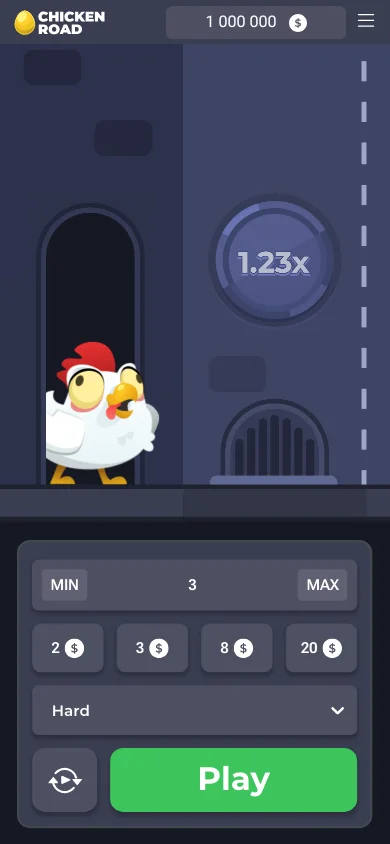
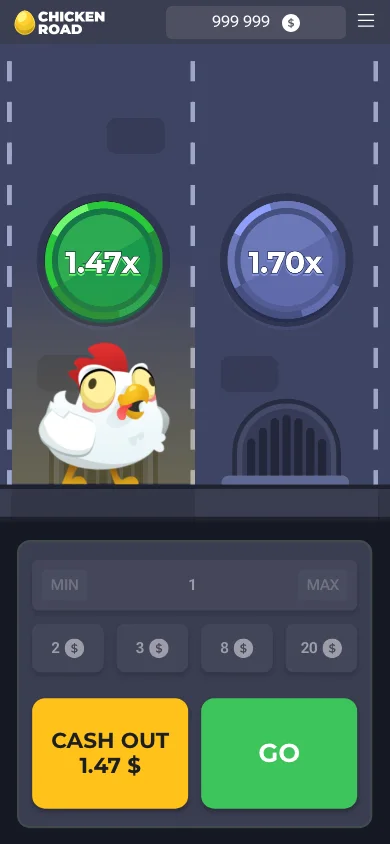
Chicken Road · Our demo capture
Chicken RoadVirtual credits
Chicken Road · Our demo capture
Chicken RoadVirtual credits
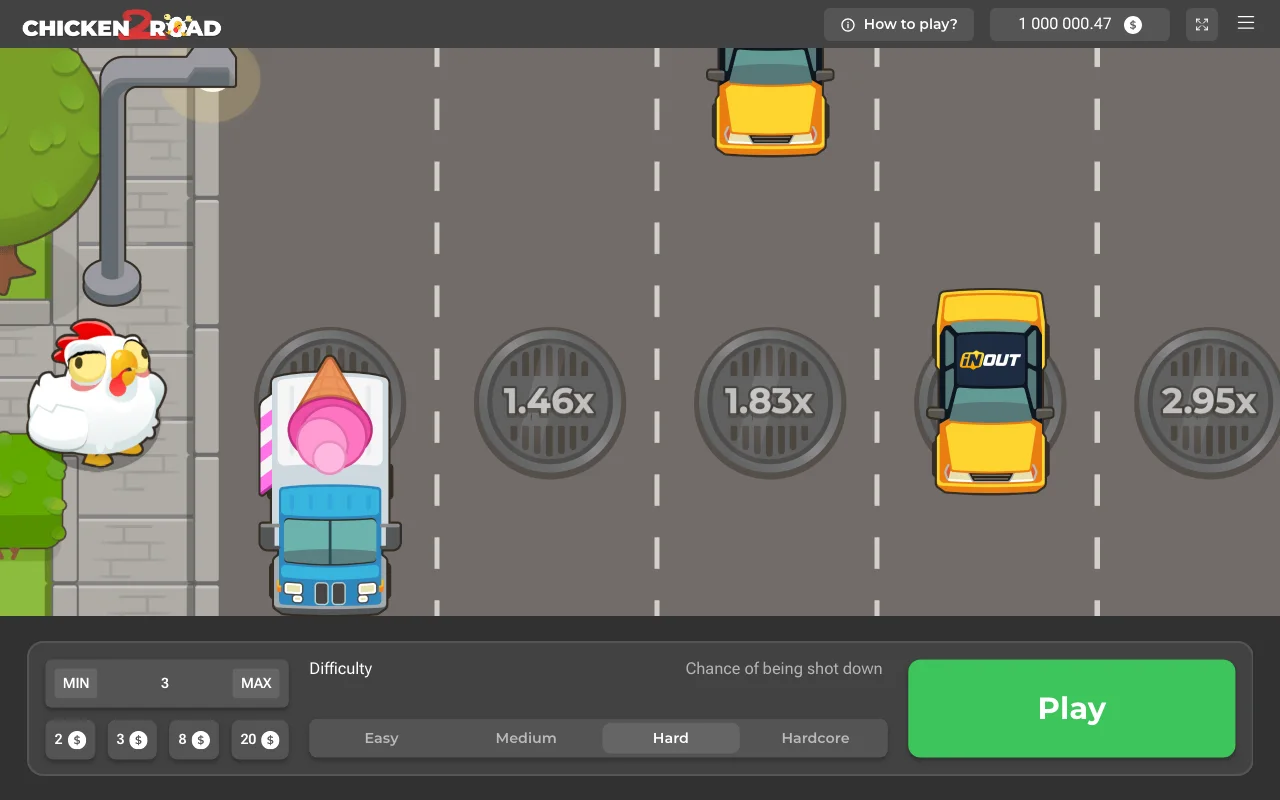
Chicken Road 2 · Our demo capture
Chicken Road 2Virtual credits
Chicken Road 2 · Our demo capture
Chicken Road 2Virtual credits

Read next

Find the answer you need

Your stake, one crossing and a decision

You do not steer around traffic with arcade skill. The game resolves the outcome; your decisions concern the stake, difficulty and when to cash out after successful progress. That makes the numbers more useful than the speed of your tapping. Before starting, identify the amount at stake, the mode and the collection button. On a small phone display, enlarge the play area until all of them are clear.

Chicken Road Wins puts those decisions together for players. Your account currency helps you think about a personal spending allowance, while the provider's limits below remain in USD. A balance in a casino account does not turn a USD game limit into the same number in another currency.

Start by choosing which Chicken Road you mean

The original and Chicken Road 2 share the move-or-collect idea, but their ladders are different. The first title gives you 24 Easy positions, 22 on Medium, 20 on Hard and 15 on Daredevil. The sequel extends those roads to 30, 25, 22 and 18 positions respectively. More positions means more decisions along the route; it does not mean that reaching the far end becomes certain.

There are financial differences too. Original stakes run from 0.01 to 150 USD, with a maximum win of 10,000 USD. For the sequel, the stake range is 0.12–200 USD and the maximum win is 20,000 USD. A maximum is a ceiling on a round, rather than the balance you should expect to collect.

The first game's review explains its crossing controls. Compare the two return percentages before carrying any figure into the sequel.

Use a free attempt to read the cash-out amount

Open the demo with practice credits and leave the stake alone for the opening attempts. After a successful move, pause and look at the amount available to collect. Then compare it with the multiplier on the next position. The first amount is available at the current point; the next value requires another successful crossing. Confusing those two figures is an easy way to misunderstand a promising screen.

Collect during a practice attempt so you can see the balance settle. In another attempt, follow a failed move and see the stake leave the demo balance. Neither event creates money to withdraw. The useful part is recognising how the interface distinguishes an active round from a completed one.

If your connection drops, return to the same view and check the round status before touching another control. A reloaded practice balance can change or reset. It is there to make the controls understandable, rather than to build a balance for a later bank transfer.

Four modes change the size of each jump

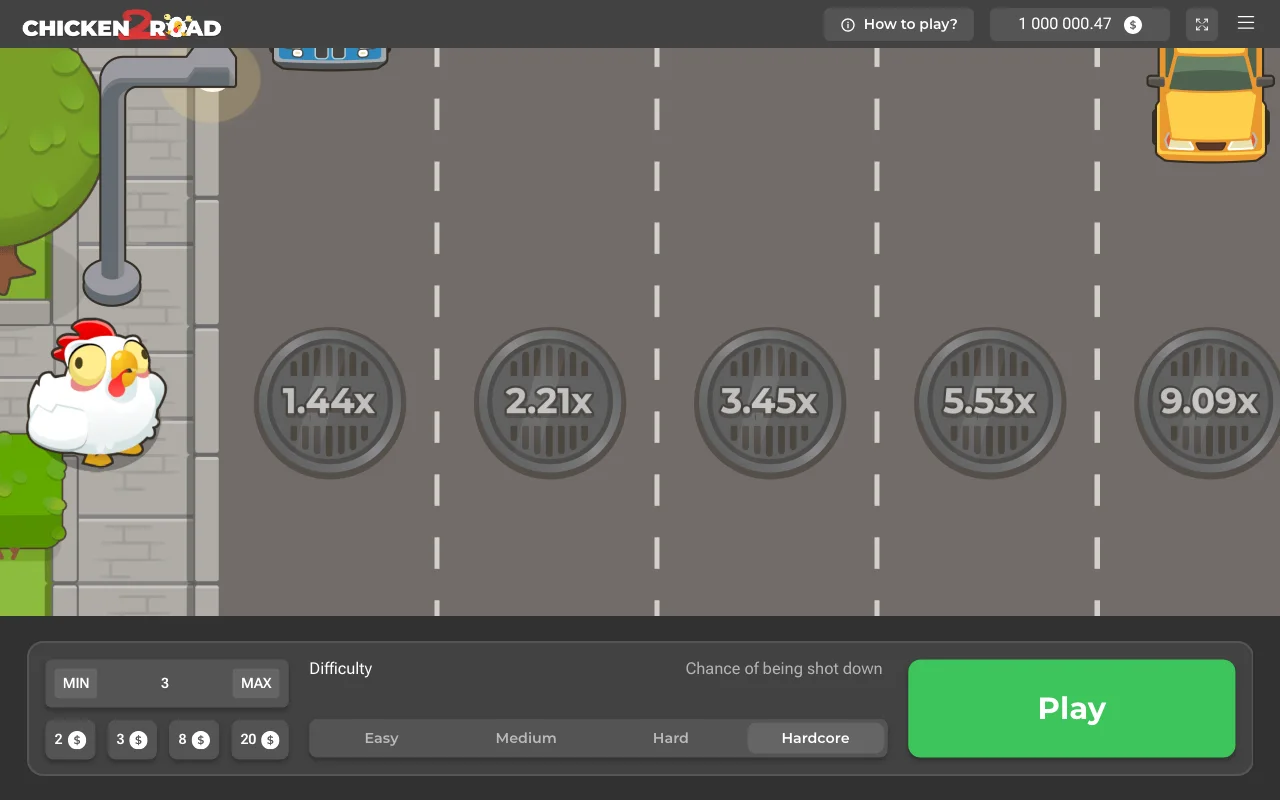
To understand the game overview, original Easy opens at ×1.03 and ends at ×19.44. Medium begins at ×1.12 and finishes at ×1,788.80. Hard opens at ×1.23 and ends at ×41,321.43; Daredevil starts at ×1.63 and reaches ×2,542,251.93 at its final position. The endpoints attract attention, but the opening values tell you more about the immediate choice on a fresh round.

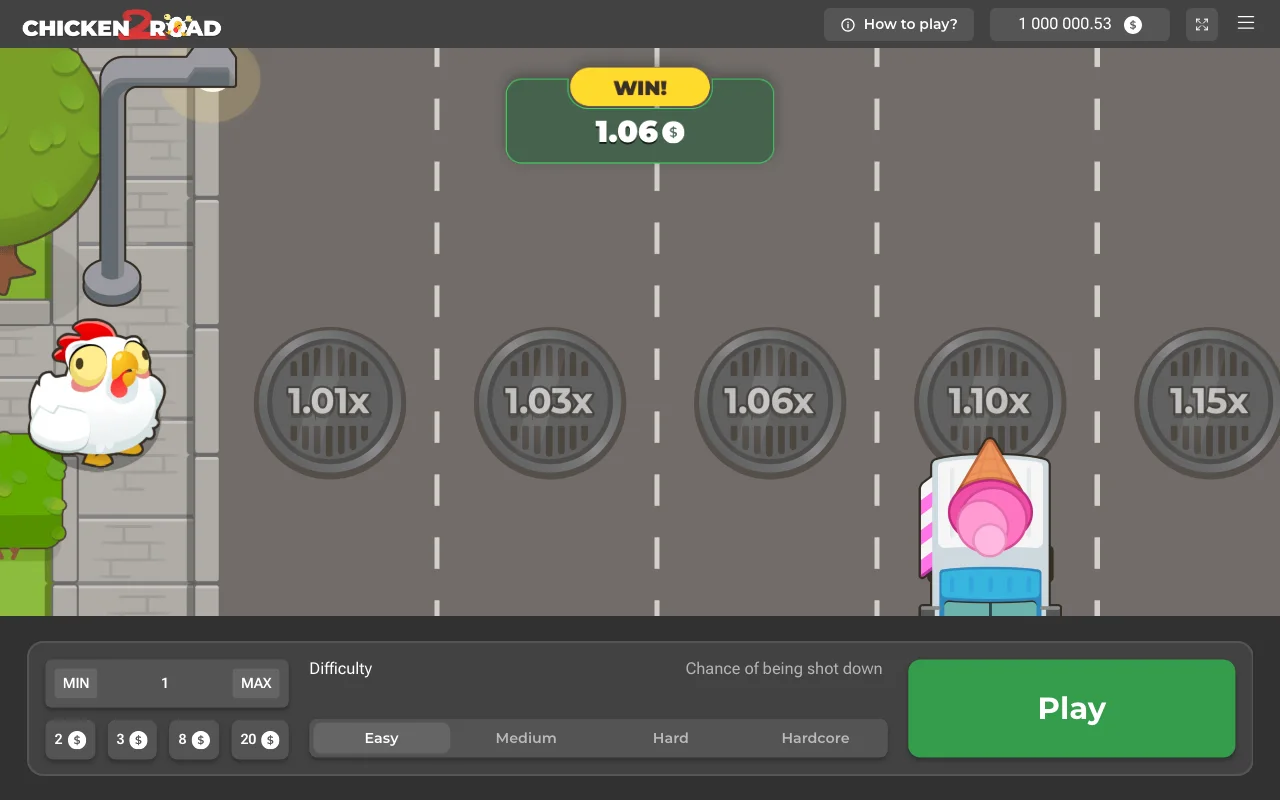
The sequel begins more gently on its longer Easy road: ×1.01, followed by ×1.03 and ×1.06. Its other opening multipliers are ×1.08 for Medium, ×1.18 for Hard and ×1.44 for Daredevil. Compare the same mode within the same title before trying to interpret a particular position number.

Shorter roads have much sharper multiplier increases. A large increase does not reveal whether the next move will succeed. Choose a setting by reading the whole ladder and trying its controls in demo, rather than treating the most dramatic endpoint as a reason to increase your stake.


Read the round totals beside their labels

The statistics blocks bring the completed demo attempts together. Read the title, mode and dates above a chart before comparing its totals with another chart. A road with more attempts provides a different amount of information from a road tried only briefly. A count without that context can make a rare-looking event seem more meaningful than it is.

Survival charts describe how far those attempts progressed. A multiplier ladder describes what a position pays if reached and collected. Those are different questions, even when both graphics use a step number across the bottom. Match the labels before drawing a conclusion from the shape of a line.

The tables contain the actual totals, so there is no need to turn a single standout round into a general claim. A sequence of failures does not make a crossing due to succeed. A strong demo run cannot verify the sequel’s published RTP or tell you when to start a cash session.

Multiply first, then look at the payout ceiling

A cash-out multiplier produces a gross return by multiplying the round stake. That gross figure includes the amount originally committed. It is different from the amount gained above the stake. Read the calculator's labels carefully before comparing its result with your account balance; otherwise the same stake can accidentally be counted twice.

For example, the first game's Easy ladder contains ×2.04 and ×3.06. Those coefficients describe returns at different positions. They do not say that you can choose either amount at the start of a round. You must reach a position successfully before its return becomes a collection choice.

The provider ceiling matters when the product of stake and multiplier becomes very large. A displayed endpoint with many digits does not remove the 10,000 USD maximum for the original or the 20,000 USD maximum for the sequel. Use a calculator to understand that relationship, then read the actual game rules for the amount applying to your account currency.

Check a cashier before transferring money

Find the exact InOut title in the casino lobby rather than relying on a similar chicken picture. Then read how to use the casino account, which identity checks it requires and which methods you can use to withdraw. A game screen explains the round. The casino handles the deposit, holds the account balance and receives a withdrawal request. A logo beside a deposit button does not tell you the withdrawal route, fees or whether the account must use a matching name. Read those details before sending money, and keep the provider's minimum game stake separate from the casino's minimum deposit. A page loading on your phone cannot tell you whether local rules allow you to play. If you do not understand a payment or account rule, ask the casino to explain it before starting a real-money round.

Give your phone screen enough room

The browser is a practical place to try these Chicken Road games on a phone. Keep the stake and collect control visible together. If a browser toolbar covers the lower part of the game, change orientation or enlarge the game view while no round is active. Check the chosen mode again after returning from another tab.

To understand the game overview, inOut does not supply a standalone Chicken Road app. A store listing or installation file bearing the name may be a third-party title or clone. The app page explains how to distinguish mobile browser access from an unrelated installer without sending you through a file download.

Connection quality matters for reading the round status, especially when mobile data becomes slow. Repeated taps cannot make the server respond faster or turn a failed move into a success. If the screen stalls, stop adding actions and let the game or casino show how the pending round settled.

Take the question to the right page

Choose the original review for its complete mode figures and the sequel review for its separate limits. Use the difficulty page when the search term hardcore has brought you here; the game labels you need are Easy, Medium, Hard and Daredevil. The comparison page puts both versions together without pretending one suits every player.

For a first look, the demo and how-to-play pages explain the stake and collection controls. For an account issue, move to the login and payments topic. A bank transfer question belongs with the casino handling that transaction, whereas a multiplier question belongs with the game ladder.

Our predictor page addresses sellers offering paid signals or bots. Server-side random outcomes cannot be read from a screenshot or a Telegram message. A familiar run of results is not a schedule for the next crossing. Use the mechanics to understand your choices. Someone selling certainty about the next random move cannot know that result.

Keep the road inside your leisure budget

Adults 18+ only: choose time and money limits before using the game overview, take breaks and never chase losses.

Playing from your region?

These methods are often available — check the cashier. Check the relevant state lottery regulator and current Nigerian licensing requirements rather than relying on an NLRC label alone.

Read the local play guide →

Player answers

Which controls start a crossing and end the round?

In this InOut title, you choose a stake and difficulty, then decide whether to move again or cash out after a successful crossing. A failed move loses that round’s stake. It is a gambling game rather than the separate playground or driving activity with a similar name.

Where does Chicken Road 2 fit in the series?

Chicken Road 2 is the sequel with its own multiplier ladders, 30/25/22/18 positions by difficulty and a 20,000 USD maximum win. Its RTP is 95.5% per InOut, so the original title’s percentage should not be attached to it.

Can a bank transfer fund the demo?

The demo uses practice credits and needs no money to make those credits valuable. For a casino cash balance, payment availability depends on that casino’s cashier. Sending a bank transfer does not convert a practice balance into withdrawable cash.

Do the biggest multipliers bypass the game limit?

No. The provider’s maximum payout still applies to a round. A large coefficient explains the ladder at that position; it does not create an unlimited payment or replace the casino’s separate withdrawal conditions.

Does tapping faster improve the next crossing?

No. The outcome comes from the game’s random system, not your phone tapping speed. Concentrate on reading the current stake, mode and collection amount rather than trying to find a secret rhythm.

18+

Keep play in perspective

Gambling involves a risk of losing money. Set time and spending limits, never chase losses, and use support if play stops being enjoyable.