Move to the main page text

Free play, crossing odds and captured rounds

Discover the Chicken Road Game and Try Both Versions

Chicken Road is a casino game by InOut where each crossing can raise the available return or end the round. Try both free demos and examine our 12,000-round test alongside the odds.

Play free demo
Developer-stated return 98% Modes 4 Maximum game payout 10,000 USD Bet range 0.01–150 USD

Chicken Road Wins research team

Chicken Road game artwork
Our demo capture18+

Use practice credits

Chicken Road
Chicken Road

Free practice credits. No withdrawals. Adults 18+.

Developer-stated return: 98% · Maximum game payout: 10,000 USD · Pounds for personal spending plans: GBP (£); the game's provider limits are quoted in USD

Explore this game's details
2Games, separate facts
4Difficulty modes
98%Provider RTP · original game
12,000Recorded demo rounds

Pick your road

4 modes. Different ladders.

A harder mode changes the steps and multipliers. It does not make the next outcome predictable.

Easy difficulty

24 Steps

19.44×Final step coefficient · original game

Medium difficulty

22 Steps

1,788.8×Final step coefficient · original game

Hard difficulty

20 Steps

41,321.43×Final step coefficient · original game

Daredevil difficulty

15 Steps

2,542,251.93×Final step coefficient · original game

Coin artwork is decorative. The figures above come from the recorded game configuration.

Our test

12,000 demo rounds

Continued to loss or completion. Observations only. No outcome forecasts.

Easy difficulty95.47%Statistical uncertainty interval: 94.29%–96.41%
Medium difficulty87.8%Statistical uncertainty interval: 86.05%–89.36%
Hard difficulty81.67%Statistical uncertainty interval: 79.63%–83.54%
Daredevil difficulty59.4%Statistical uncertainty interval: 56.89%–61.86%

Original game · survival at the first step · pointwise Wilson intervals

The game family

The original and the sequel

Chicken Road game artwork

Chicken Road

Developer-stated return
98%
Maximum game payout
10,000 USD
Steps
24 / 22 / 20 / 15
Bet range
0.01–150 USD
Explore this game's details
Chicken Road 2Chicken Road 2

Chicken Road 2

Developer-stated return
95.5%
Maximum game payout
20,000 USD
Steps
30 / 25 / 22 / 18
Bet range
0.12–200 USD
Explore this game's details

Our own demo captures

See the game on screen

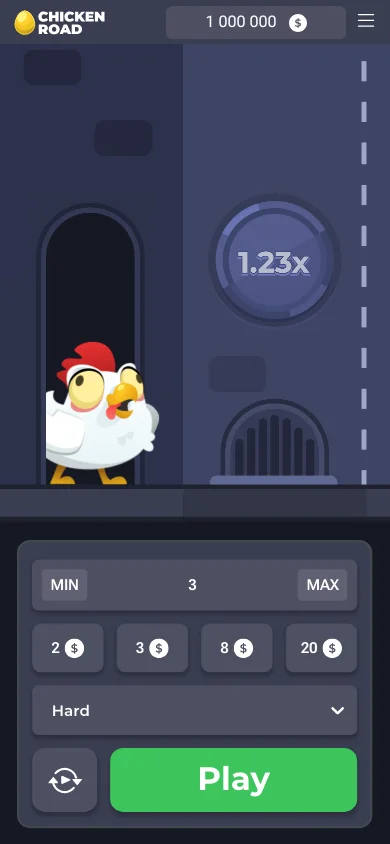
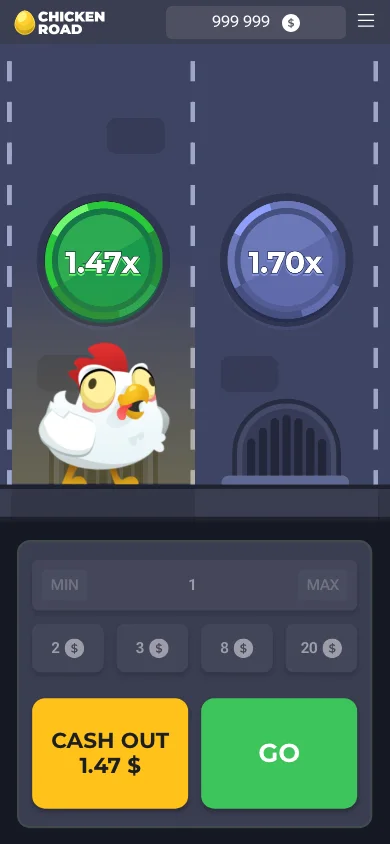
Chicken Road · Our demo capture
Chicken RoadVirtual credits
Chicken Road · Our demo capture
Chicken RoadVirtual credits
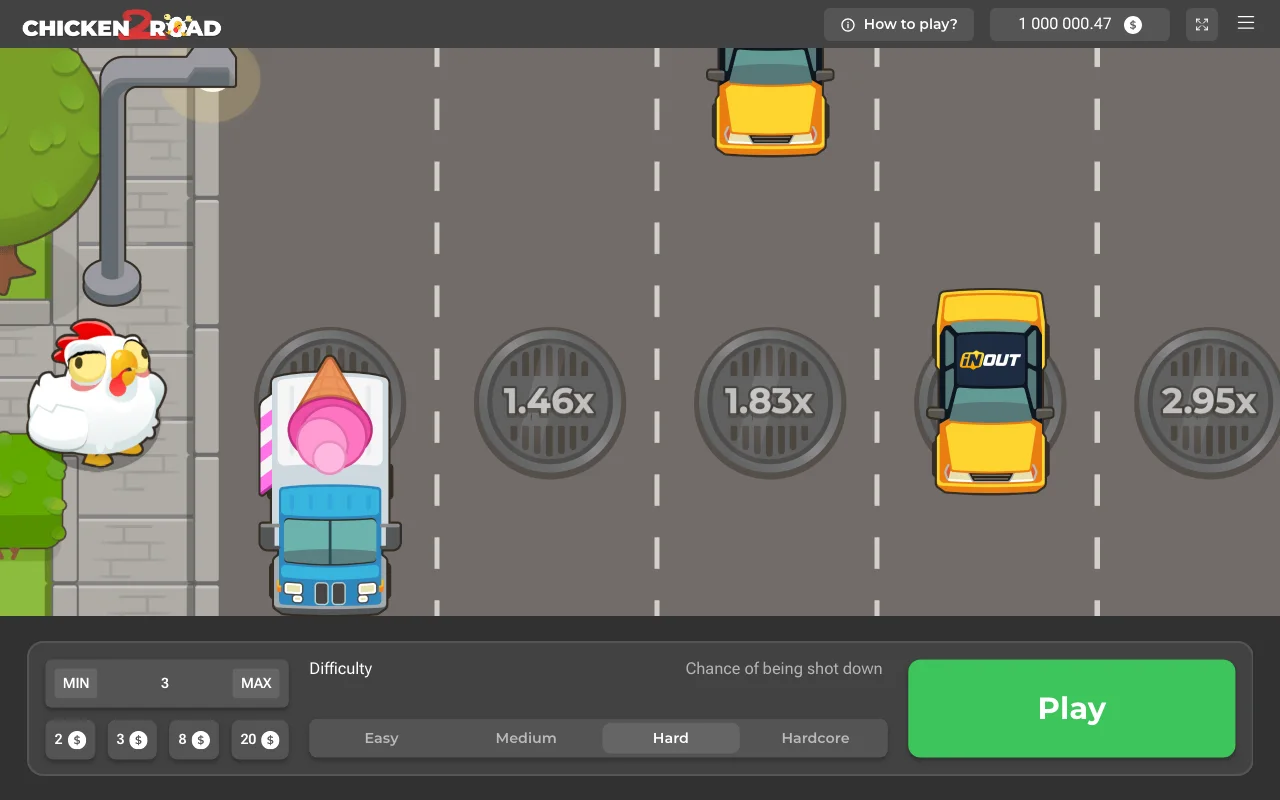
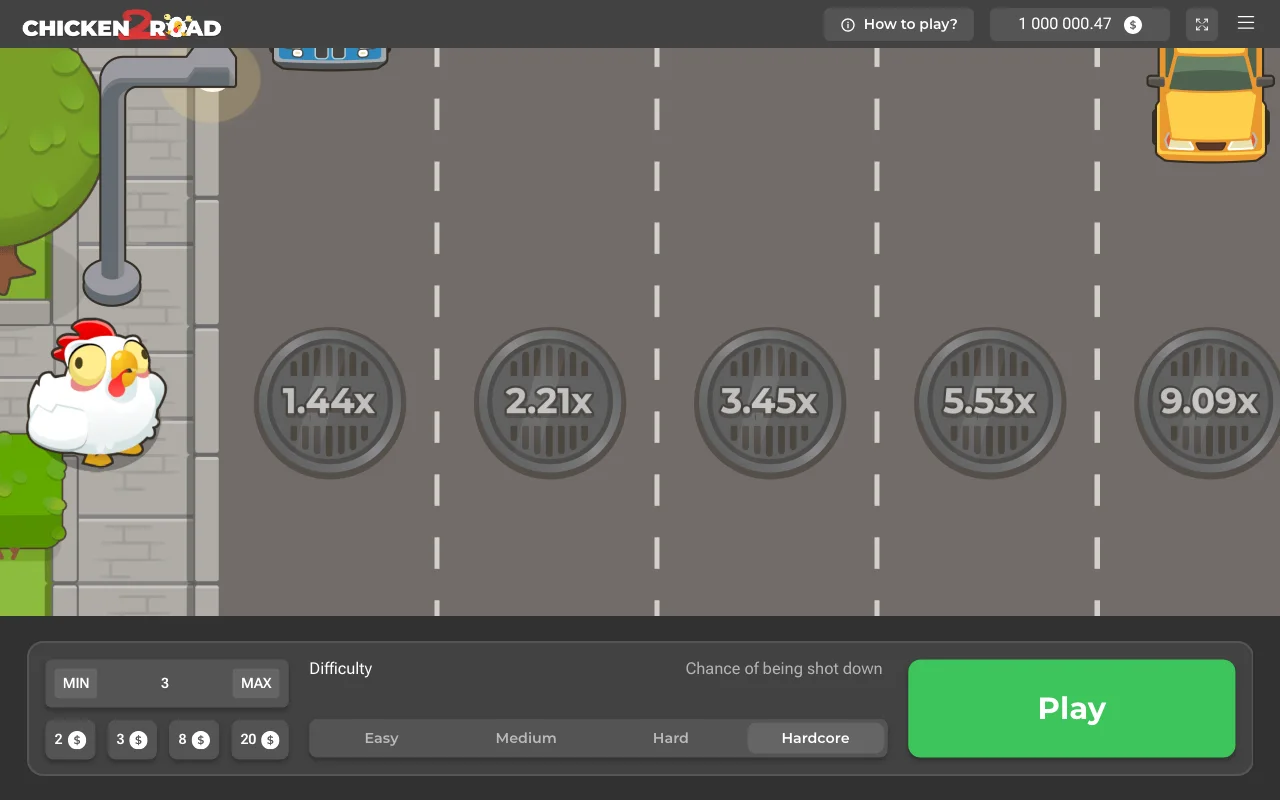
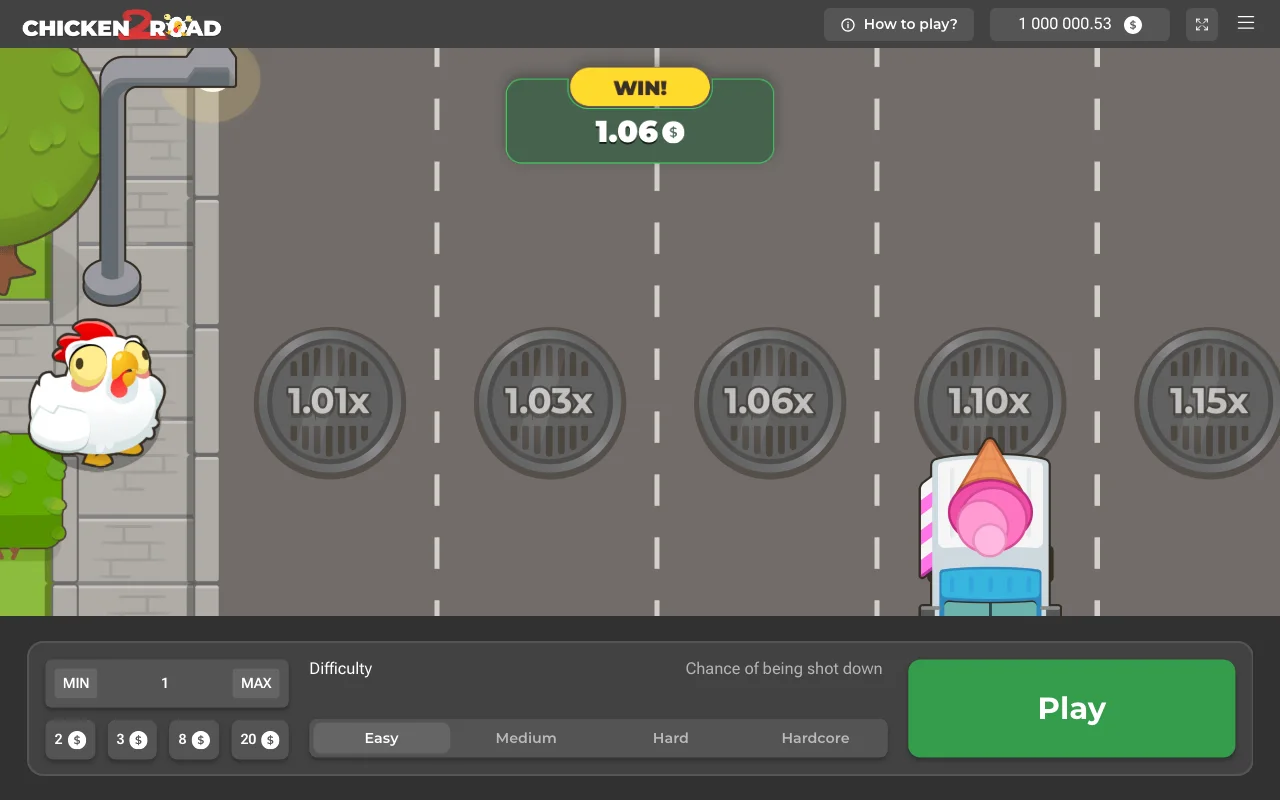
Chicken Road 2 · Our demo capture
Chicken Road 2Virtual credits
Chicken Road 2 · Our demo capture
Chicken Road 2Virtual credits

Read next

Find the answer you need

The game revolves around the next collect decision

The road animation can resemble an arcade game, but you are not manoeuvring through traffic by skill. The outcome is random. What you choose is how much to stake, which difficulty to use and whether to finish after a successful move. Those controls are the useful starting point for understanding the screen.

Chicken Road Wins brings the practical figures together for players. Keep a spending plan in the currency you use for leisure costs. Leave the provider's USD stake and payout figures in their original currency. No exchange rate is assumed, and a smaller-looking number in dollars should not be treated as the same number in another currency.

Two titles share an idea, with separate ladders

The original Chicken Road has four difficulties: Easy over 24 positions, Medium over 22, Hard over 20 and Daredevil over 15. Chicken Road 2 keeps those labels but extends the lengths to 30, 25, 22 and 18 positions. A familiar selector therefore does not mean the coefficients behind it are unchanged.

Provider stakes for the first game run from 0.01 to 150 USD and its maximum win is 10,000 USD. The sequel runs from 0.12 to 200 USD with a 20,000 USD maximum. These game limits are separate from anything an operator states about deposit sizes or withdrawal processing.

Start with the original game review, then compare the two published return rates. Each version has its own roads and limits.

Try collecting once with practice credits

The demo is a useful first stop because it lets you see a round close without placing cash at stake. Choose a difficulty, leave the practice stake steady and watch an opening crossing. When it succeeds, locate the amount that can be collected. Compare it with the coefficient on the following position, which still needs another successful move.

Press collect during a practice attempt and follow the balance update. Then notice how the interface marks a completed round. The animation is only part of what happened: the status and balance tell you whether another decision is still active. That distinction matters more than seeing how quickly you can press a button.

Practice credits do not carry withdrawal value. They cannot become a bank payment after a deposit, and a strong demo run is not a forecast for a cash session. You can finish the demo as soon as you understand the controls, even if the practice balance is lower than when you began.

Compare the start of a mode as well as its finish

In the original, Easy begins at ×1.03 and ends at ×19.44. Medium begins at ×1.12 and reaches ×1,788.80; Hard starts at ×1.23 and reaches ×41,321.43. Daredevil opens at ×1.63 and its final coefficient is ×2,542,251.93. The dramatic end values should be read with the route between them, rather than as amounts waiting at the start.

Sequel Easy opens at ×1.01 and finishes at ×23.24. Its other opening coefficients are ×1.08, ×1.18 and ×1.44 for Medium, Hard and Daredevil. If you switch games while keeping the same mode name, read the full ladder again. Position numbers alone do not identify the same return in both titles.

A sharper rise in the ladder does not reveal a safe next move. Once you know the layout, you can find the collect amount more easily. That familiarity cannot change the random result of a crossing. The practical comparison is between the offered amounts and route lengths, with the correct game cap alongside them.


The charts describe a particular run of demo play

The statistics blocks identify the title, difficulty and period behind their figures. Check those details before comparing the biggest multiplier or a survival line. A set of Easy attempts and a set of Daredevil attempts answer different questions about different ladders, even when the graphics look similar.

Survival tells you how far the attempts in that run went. A coefficient table tells you the amount offered at a position if it is reached and collected. When checking the game overview, the survival line shows how far completed rounds went. The ladder lists the multiplier at each position, whether or not those rounds reached it. Reading both is useful as long as their meanings stay separate.

A striking result does not tell the whole story of a run, and a line with several early failures does not make a later success due. Look at the counts and the spread of outcomes rather than only a peak. None of these totals can verify the sequel’s published RTP or disclose the next random result.

A gross return is bigger than the gain alone

Multiply a stake by the coefficient at a reached position to work out the gross amount before the cap. Gross includes the original stake. It is therefore different from the gain above that stake, and the distinction should remain consistent when you compare the calculator with a changing balance.

Original Easy includes ×2.04, ×3.06 and ×4.90 along its route. They are collection coefficients at separate positions, not a menu of payments to choose before a round. A future position must be reached before its amount becomes available. The screen's current collect figure is the one attached to progress already made.

The payout ceiling matters when multiplication produces very large numbers. The original stops at a 10,000 USD maximum win and the sequel at 20,000 USD. Those caps do not disappear because the final coefficient has many digits. A calculator should make the relationship clearer, rather than turn an endpoint into a promise of unlimited payment.

Understand the casino around the game

Look up the operator’s licence before depositing or starting a cash round. A page loading or a title appearing in a search result does not show that the casino meets that requirement. The exact business holding an account matters as much as the game's familiar name. Look separately at deposit and withdrawal routes, charges and any currency conversion. A logo is a starting point for reading, rather than a complete description of how a payment will work for your account.

The game's USD minimum stake is not a casino's deposit minimum. A stated maximum win is not a universal withdrawal schedule either. If an account term remains unclear, ask the operator about that term before sending money. The game ladder cannot answer a question about the recipient or status of a bank transfer.

Keep the current amount visible on a phone

Browser play can put the road on a phone without a separate game installer. Before starting, find the stake field, mode and collect control in the same comfortable view. Expand or rotate the play area while no round is active if the browser's toolbar makes the controls cramped.

When checking the game overview, inOut does not supply a standalone Chicken Road app. Similarly named app-store products can be third-party games or clones, while a casino's own app is a different account product. A familiar chicken icon is not proof that an unfamiliar installation file belongs to InOut.

If the connection pauses, give the round time to settle before adding more inputs. A stalled animation does not reveal the outcome and repeated taps do not improve it. Return to the actual game status or account history when something is unclear, rather than relying on a frozen picture.

Choose a page by the question you still have

The individual reviews take each title's figures in full. The difficulty page explains why a search for hardcore should lead you to the four actual selectors. The side-by-side comparison is useful when you want to see changed lengths and limits without treating the sequel as automatically better.

The how-to-play page follows the stake and collection controls. Account and bonus pages take a separate look at login, payments and promotion conditions. Those questions belong with the operator's account process rather than with a multiplier you might reach during a round.

For predictor claims, use the hack topic. Public past results cannot expose a server-side random outcome. A Telegram signal or bot pitch adds a sales claim, not knowledge of the next crossing. The most useful next action may simply be finding the answer you came for and closing the screen.

Keep gambling within a leisure decision

For adults aged 18+ only. Keep time and spending limits when reading about the game overview; take breaks and never chase losses.

Playing from your region?

These methods are often available — check the cashier. Online casinos in Great Britain need a UKGC licence; check the operator’s licence and access terms.

Read the local play guide →

Find a direct answer

What can I choose after a successful crossing?

You may collect the amount currently offered or attempt another step. Collecting settles that round; continuing exposes it to a possible loss.

Can I open both versions without a casino account?

Both browser demos on these pages use free credits and require no registration. Try each version separately to see its own controls and difficulty ladders.

Which version has more Easy positions?

Chicken Road 2 has 30 Easy positions, compared with 24 in the original. Their opening coefficients differ too, so compare the ladder for the exact title rather than just counting tiles.

Can the biggest coefficient bypass a payout limit?

No. The provider cap remains part of the game: 10,000 USD for the original and 20,000 USD for the sequel. A multiplication result above that amount is not an unrestricted payout.

Can I use demo totals to predict a cash round?

No. The figures describe the demo attempts shown beside their title, mode and dates. They do not identify a future safe crossing or make a sequence of losses due to reverse.

18+

Keep play in perspective

Gambling involves a risk of losing money. Set time and spending limits, never chase losses, and use support if play stops being enjoyable.